

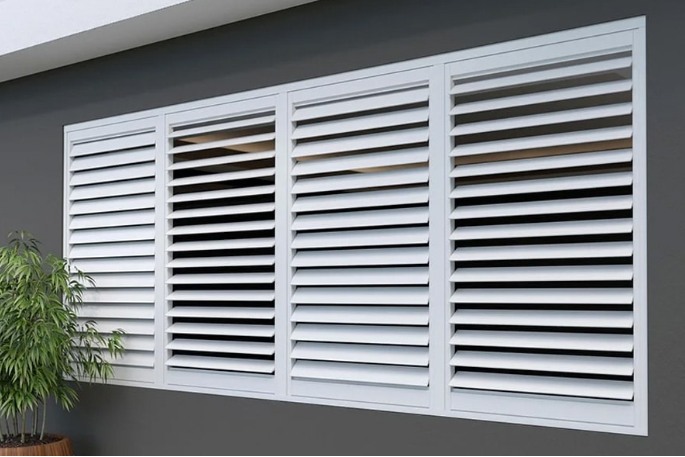
Most Australian homeowners have spent years layering internal window treatments on top of a problem that internal window treatments cannot solve. Roman blinds, blockout curtains, and honeycomb shades all intercept light after solar energy has already passed through the glass and converted to heat inside the room. The room is already warmer before the blind does anything. External plantation shuttersoperate on a different principle entirely — they intercept radiation before it reaches the glazing, which is why homes fitted with them feel genuinely different rather than marginally more manageable during summer.
West-Facing Rooms Have a Specific Problem
West-facing glazing in an Australian home receives direct afternoon sun during the hottest hours of the hottest days. Internal blinds pulled against this create a dim, hot room. The heat is present whether the blind is open or closed — closing it just removes the light without addressing the temperature. An external shutter on the same window, with louvres angled to deflect direct sun whilst allowing air movement, produces a room that is genuinely cooler and still connected to the outside. The distinction is not subtle after the first summer. Homeowners with west-facing living areas or bedrooms who have installed external shutters consistently describe the change in those rooms as more significant than any other single modification they have made to the property.
The Louvre Angle Is Doing Several Jobs at Once
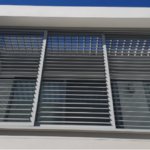
This is the functional detail that separates external plantation shutters from fixed external shading products. A fixed awning blocks the sun at one angle for one season and creates a dark, enclosed feeling when the sun shifts. The adjustable louvre on a plantation shutter tilts to follow the sun’s position, admits morning light whilst blocking afternoon glare, allows cross-ventilation whilst maintaining privacy, and closes fully for weather protection or security. The same fitting performs genuinely different functions across a single day without any product change. Homeowners who replace a fixed awning with an external shutter often remark that they had not realised how limiting the fixed product was until they had something adjustable to compare it against.
Cheap Specification Fails Visibly and Early
Australia’s UV index, coastal salt air, and temperature cycling between summer highs and cool nights create conditions that expose under-specified external products faster than most homeowners expect. Louvres that are not engineered with adequate wall thickness and internal reinforcement warp under thermal cycling — they stop closing flush, develop gaps, and eventually jam. Powder coating applied over inadequately prepared aluminium begins lifting at edges and penetration points within a few seasons of coastal exposure. External plantation shutters that perform across a decade of Australian conditions require UV-stable louvre compounds, marine-grade powder coating for coastal installations, and stainless steel fixings at every connection point. These are not specifications to negotiate away for a lower quote — they are the difference between a product that lasts and one that needs replacing.
Facade Coherence Is an Underrated Outcome
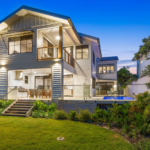
There is a visual consequence to external shutters that homeowners frequently underestimate until the installation is complete. Consistent shutter profiles across a facade create an architectural rhythm that transforms how a home reads from the street. Properties in Queensland and New South Wales that have incorporated external shutters into the window arrangement are presented as resolved and considered rather than incrementally modified over time. This matters at the sale. Buyers form impressions of a property before they walk through the front door, and a facade with coherent external shutters reads differently — and more favourably — than one where each window has been addressed with a different product at a different time.
Roller Shutters Solve the Wrong Problem
Security roller shutters are effective but visually punishing. The corrugated profile, the bulky housing above the window opening, and the industrial aesthetic they impose sit uncomfortably on homes where presentation matters. Plantation shutters achieve comparable physical security in the closed position — the louvre assembly resists casual forced entry — without reading as a commercial security installation. The security is present without announcing itself, which is the outcome most homeowners actually want when they say they want a secure home that still looks like a home.
Conclusion
External plantation shutters resolve several problems simultaneously that most Australian homeowners have been managing separately with less effective products. The functional shift — particularly on west-facing elevations and in coastal environments — tends to exceed initial expectations. Specification quality determines whether the product delivers on that promise across years rather than seasons. Homes that get both the product selection and the specification right consistently outperform those where either variable was treated as a secondary consideration.